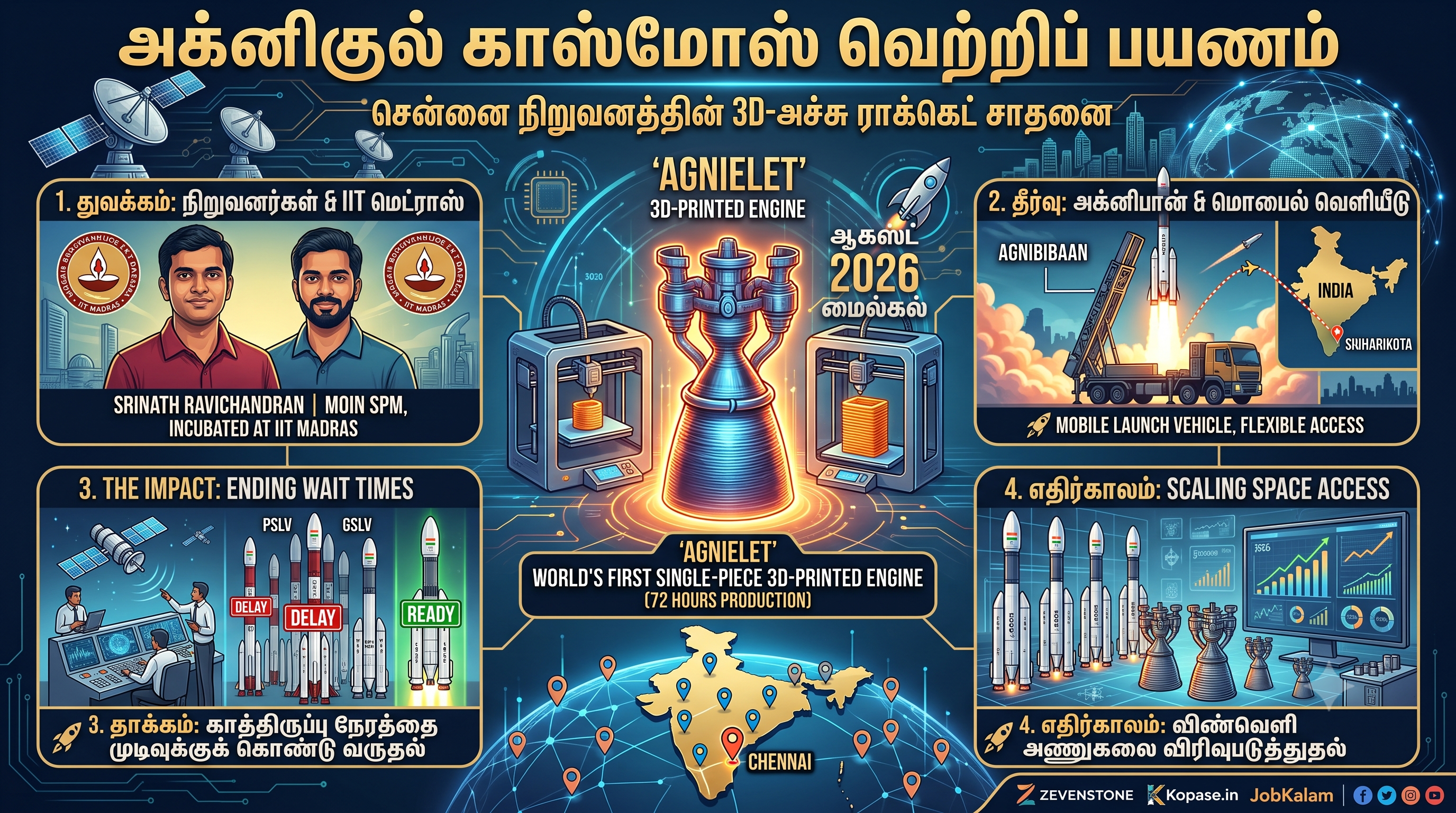
The 3D-Printed Rocket Revolution by Chennai’s Agnikul Cosmos
The Problem: The Wait for Space Access While the demand for launching small satellites for communication, weather, and agriculture is booming, companies often have to wait months to piggyback on large rockets. This delay makes space access highly expensive and inefficient for small-scale operations.
The Innovators: Srinath Ravichandran & Moin SPM Incubated at IIT Madras, space tech enthusiasts Srinath Ravichandran and Moin SPM founded ‘Agnikul Cosmos’. Their vision was simple but highly ambitious: to make launching a satellite as easy as booking a cab.
The Solution: ‘Agnibaan’ and the 3D-Printed Engine The team developed ‘Agnibaan’, a highly customizable, mobile launch vehicle. The real game-changer is its engine, named ‘Agnilet’. Traditional rocket engines consist of thousands of parts that take months to assemble. Agnikul disrupted this by building the world’s first single-piece, 3D-printed rocket engine, manufactured in just 72 hours. Furthermore, their mobile launchpad allows the rocket to be launched from virtually anywhere.
The Mega Success: Following rigorous testing, Agnikul successfully executed their maiden sub-orbital test flight from Sriharikota. Securing millions in global funding, this Chennai-based startup has put India’s private space sector on the global map, competing directly with international space tech giants.