IAS Success Story: Pranjal Patil – India’s First Visually Impaired IAS Officer Who Redefined Possibility
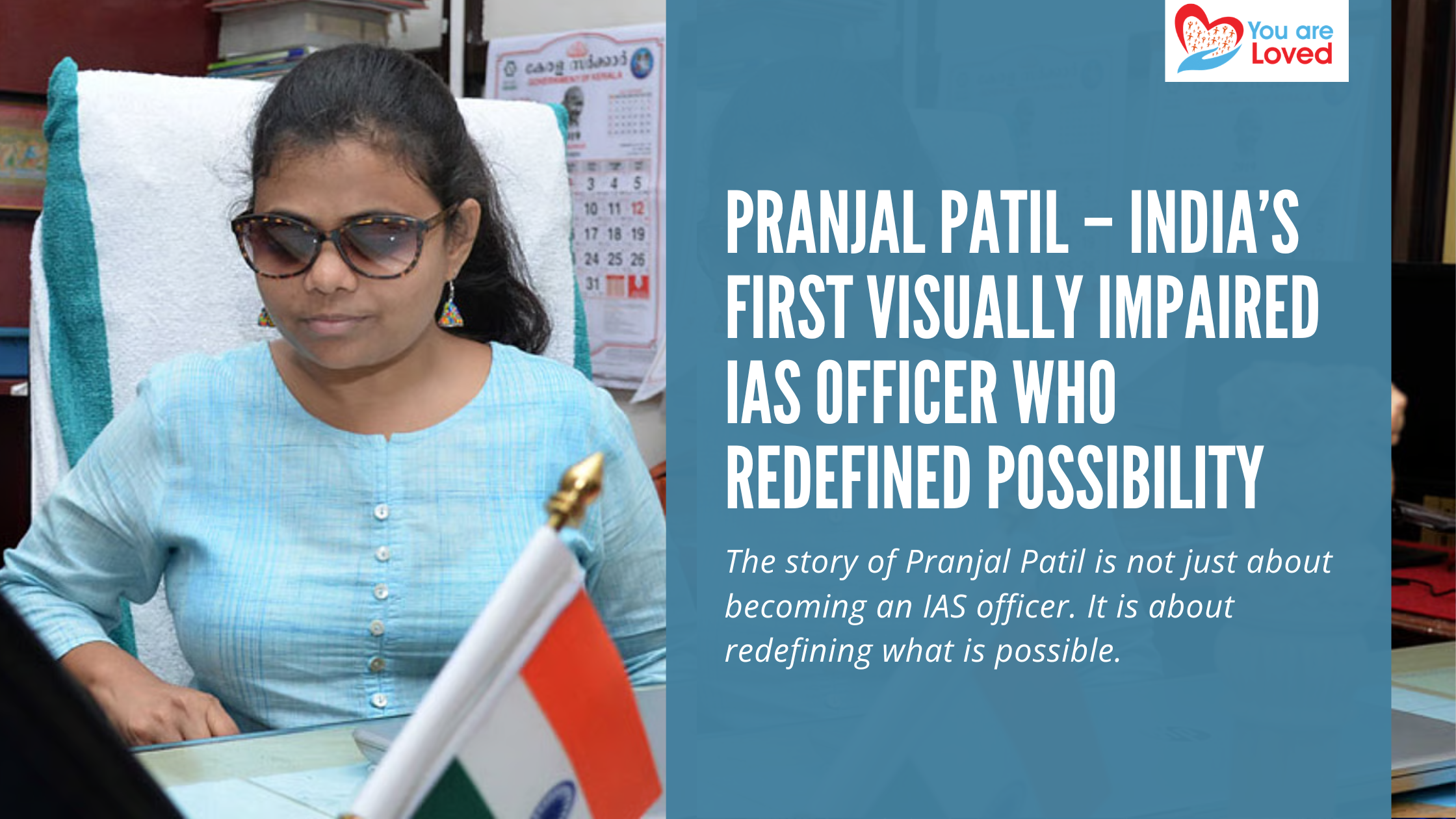
Some success stories don’t just inspire, they change how people see limits.
The journey of Pranjal Patil is one such story. From losing her eyesight at a very young age to becoming one of India’s most respected IAS officers, her path proves that ability is never defined by physical limitations, but by mindset and persistence.
She didn’t just clear UPSC. She changed what people believed was possible.
Early Life and Struggles
Pranjal Patil was born in Ulhasnagar, near Mumbai, Maharashtra. Her early childhood was normal until the age of six, when she suffered retinal detachment and lost her vision completely.
For many families, such a situation would shift expectations downward. But her parents made a different choice. They ensured she studied in regular schools instead of separating her into a different system. This decision played a major role in shaping her confidence and independence.
Education and Academic Growth
Despite her visual impairment, Pranjal continued her education with strong determination.
She studied at Kamla Mehta Dadar School for the Blind and later moved on to St. Xavier’s College, Mumbai, where she completed her graduation in Political Science. Her academic journey didn’t stop there. She pursued higher studies at Jawaharlal Nehru University, Delhi, completing her Master’s in International Relations and later continuing toward research-level studies.
Her exposure to governance, policy, and international affairs at JNU helped shape her interest in civil services.
Decision to Attempt UPSC
The UPSC Civil Services Examination is one of the toughest exams in India, demanding intense preparation, consistency, and mental strength.
For Pranjal, the challenge was even greater due to accessibility barriers. But she chose to face it directly rather than step away.
She relied heavily on audio learning tools, screen readers, and digital resources to study. With strong family support and consistent effort, she entered the UPSC journey with full commitment.
UPSC Attempts and Breakthrough
Pranjal first cleared the UPSC Civil Services Examination in 2016, securing an All India Rank of 733. However, she faced unexpected challenges during service allocation due to concerns raised about her disability.
Instead of accepting limitations placed on her, she chose to try again.
In her next attempt in 2017, she improved her performance significantly and secured All India Rank 124, which led to her selection into the Indian Administrative Service (IAS).
This marked the beginning of her official journey as an IAS officer.
Training and First Posting
After selection, Pranjal trained at the Lal Bahadur Shastri National Academy of Administration in Mussoorie. The training included physical exercises, administrative learning, and field-based exposure.
Despite accessibility challenges, she completed her training successfully.
Her early postings included roles in Kerala, where she served in administrative positions such as Assistant Collector in Ernakulam and later Sub Collector in Thiruvananthapuram. Her performance gained national attention for breaking long-standing stereotypes about disability in governance.
District Leadership and Administrative Work
Pranjal’s career continued to grow as she took on more responsible roles, including district-level leadership positions.
She handled key administrative responsibilities such as land management, public grievance handling, and coordination of development programs. In later postings, including in Tamil Nadu, she continued to serve with consistency and focus on public welfare.
Her work demonstrated that leadership is defined by decision-making and responsibility, not physical ability.
Challenges and Overcoming Barriers
Her journey was not free from obstacles. She faced infrastructure limitations, lack of fully accessible systems, and societal bias. Even basic administrative processes required additional effort and adaptation.
However, she adapted through technology and determination. Screen-reading tools, voice-assisted systems, and digital platforms helped her manage daily work efficiently.
More importantly, she learned independence in movement, decision-making, and administration, which strengthened her confidence further.
Breaking Stereotypes Through Action
Pranjal Patil’s success challenged long-standing assumptions about disability in India. Her career showed that inclusion is not symbolic—it is practical and achievable when systems support equal opportunity.
She proved that disability does not reduce capability, and leadership is built through skill, not physical conditions.
Conclusion
The story of Pranjal Patil is not just about becoming an IAS officer. It is about redefining what is possible.
From losing her eyesight at a young age to serving as a district-level administrator, her journey stands as a reminder that success is built on persistence, access to opportunity, and strong willpower.
Her life continues to inspire students, aspirants, and professionals across India, proving one simple truth—limits exist only when they are accepted.